
Wednesday, December 17, 2008

The Dropa Stone Discs


The Dropa (also known as Dropas, Drok-pa or Dzopa) are, according to certain controversial writers, a race of dwarf-like extraterrestrials who landed near the Chinese-Tibetan border some twelve thousand years ago. Skeptics note, however, a number of problems with the case (and a lack of corroborative evidence), which offers significant doubt as to the reality of the more sensationalistic Dropa claims. Mainstream critics argue that the entire affair is a hoax.

Alleged Discovery -- Chi Pu Tei, a professor of archaeology at Beijing University, and his students were on an expedition to explore a series of caves in the pathless Himalayan mountains of the remote Bayan-Kara-Ula in Qinghai on the border of China and Tibet. The caves may have been artificially carved to be a system of tunnels and underground storerooms. The walls were squared and glazed, as if cut into the mountain with great heat.

They found many neat rows of tombs with short 4 ft 4 in inch skeletons buried within. The skeletons had abnormally big heads, and small, thin, fragile bodies. A member of the team suggested that these might be the remains of an unknown species of mountain gorilla. Prof. Chi Pu Tei was said to respond, "Who ever heard of apes burying one another?"

There were no epitaphs at the graves, but instead hundreds of one foot wide stone discs ("Dropa Stones") were found having 3/4 inch wide holes in their centers. On the walls were carved pictures of the rising sun, moon, stars, the land, mountains, and lines of pea-sized dots connecting the earth with the sky. Along with the discs, the cave drawings had been determined to be about 12,000 years old.

Dropa Stones

Each stone disk was reportedly inscribed with two fine grooves spiraling from the edge to a hole in the disk's center, perhaps not unlike the Phaitos Disk.

The disks were labeled along with other finds of the expedition and stored away at Beijing University for 20 years, during which deciphering attempts were unsuccessful. When the disks were closely examined by Dr. Tsum Um Nui of Beijing around 1958, he concluded that each groove actually consisted of a series of tiny hieroglyphs of unknown pattern and origin. The rows of hieroglyphics were so small that a magnifying glass was needed to see them clearly. Many of the hieroglyphics had been worn away by erosion. When Dr. Tsum deciphered the symbols, they told the story of the crash-landing of the Dropa spaceship and the killing of most of the survivors by local people.

According to Tsum Um Nui, one of the lines of the hieroglyphs reads, "The Dropas came down from the clouds in their aircraft. Our men, women and children hid in the caves ten times before sunrise. When at last they understood the sign language of the Dropas, they realized that the newcomers had peaceful intentions . . . ." Another section expresses "regret" by the Ham that the aliens' craft had crash-landed in such a remote and inaccessible mountain range and that there had been no way to building a new one to enable the Dropas to return to their own planet.

Dr. Tsum's report supposedly appeared in a professional journal in 1962. He was subsequently ridiculed to the point of self-imposed exile in Japan, where he died. The Peking Academy of Pre-history never allowed him to publish and never speak of his findings.

"Tsum Um Nui" is not a real Chinese name, and critics suggest that Dr. Tsum may not have actually existed. However Tsum Um Nui is a Japanese name adapted to Chinese language. There is no evidence of him beyond the Dropa allegations.

Further research

In 1965, Professor Chi Pu Tei and four of his colleagues were finally given permission to reveal their theory. They published it under the title "The Grooved Script concerning Space-ships which, as recorded on the Discs, landed on Earth 12,000 years ago".

The records, some 716 grooved discs later uncovered in the same caves, tell an astonishing story of a space probe sent by the inhabitants of another planet. After landing at the Bayan-Kara-Ula mountain range, the scripts allegedly say, the peaceful intentions of the aliens confused the members of the Ham tribe, inhabitants of the neighboring caves, who hunted down and killed the extraterrestrials.
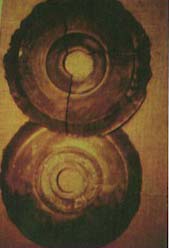
Photos claiming to show Dropa Disks are in fact Bi Disks, thousands of which have been found throughout China, mostly in the Southeastern Provinces. Bi Disks range in size of a few inches to several feet, and are most commonly made of jade or nephrite, with a round or square small central hole.

Most Bi Disks date to the Neolithic Period (c. 3000 BCE), but are found up to the Shang Dynasty Period. Bi Disks beyond the Shang Period are usually more ornate, carved with dragons, snakes and sometimes fish, and used in ritual ceremonies.

Most Neolithic Bi Disks were found in gravesites, buried beneath the head or feet of the deceased. It is theorized that this was to assist the deceased's spirit. No Bi Disks have been found to contain writing or spiral grooves as described in the Dropa story by authors such as Hartwig Hausdorf.

The Dropa Disks are said to be only 12 inches in diameter. However, one black and white photograph claimed by Hausdorf and others to display a Dropa Disk clearly shows the disk resting on a seat, and it is clearly several feet in diameter and has no markings whatsoever.

Russian Research

Russian scientists asked to see the discs and several were sent to Moscow for examination. They were scraped free of rock particles which had stuck to them and then put through chemical analysis. To the surprise of the scientists, the disks contained large amounts of cobalt and other metallic substances. What is more, when placed on a special turntable, according to Dr. Vyatcheslav Saizev, who described the experiments in the Soviet magazine Sputnik, they vibrate or "hum" in an unusual rhythm as though an electric charge is passing through them. Or as one scientist suggested, "as if they formed some part of an electrical circuit." At some time, they have clearly been exposed to extraordinarily high voltages. "They seem like ancient hard disks, spinning like the hard disks we have now days. Perhaps if we could read these ancient hard disks, we would find more answers."

Wegerer's Photos

In 1974, Ernst Wegerer, an Austrian engineer, photographed two disks that met the descriptions of the Dropa Stones. He was on a guided tour of Banpo-Museum in Xian, when he saw the stone discs on display. He claims he saw a hole in the center of each disc and hieroglyphs in partly crumbled spiral-like grooves.

Wegerer asked the managers of Banpo-Museum for more information on the pieces in the showcase. The manager knew nothing of the stones' history, though she was able to tell a complete story about all the other artifacts made from clay. She only knew that the stone discs were unimportant "cult objects".

Wegerer was allowed to take one of the discs in his hand. He estimated their weight at 1 kilogram or 2 pounds, and the diameter at one foot. The hieroglyphs can't be seen in his photos, because they have crumbled away partly, and his camera's flash washed out the fine detail, such as the spiral grooves.

A few days after his visit, the manager was called away from her job without telling her why. She and the two stone discs vanished, according to Professor Wang Zhijun, the Director of the Banpo-Museum in March of 1994.

Corroboration

In the years since the discovery of the first disc, archeologists and anthropologists have learned more about the isolated Bayan-Kara-Ula area. Much of the information has been interpreted as corroborating the story recorded on the discs.

Legends supposedly still preserved in the area speak of small, gaunt, yellow-faced men who "came from the clouds, long, long ago". The men had huge, bulging heads and puny bodies and were so ugly and repellent that they were shunned by everyone. "Men with the quick horses" hunted down the ugly dwarfs. Strangely, the description of the "invaders" is said to match that of the skeletons originally discovered in the caves by Professor Chi Pu Tei.

Criticism

Critics have largely rejected the above claims, arguing they are a combination of hoax and urban legend. For example, writer David Richie notes that the Dropa tales intrigued Gordon Chreighton, a Fellow of the Royal Anthropological Society and Royal Geographical Society. Upon investigation, Chreighton judged the sensationalistic Dropa-Extraterrestrial allegations to be "groundless," and detailed his findings in an article for Flying Saucer Review.

No traceable, credible evidence for this theory exists, or can be proven to have existed in the past. Proponents of the Dropa-stones story claim that this is the result of social disruption caused by the Chinese Cultural Revolution and of a conspiratorial coverup by Chinese authorities. However this story goes well beyond China. Its opponents claim it is long proven to be a forgery by Erich von Daniken.

Below is a detailed rebuttal of most sensationalistic Extraterrestrial/Dropa claims:

1. The discovery. There are no mentions of 'Tsum Um Nui' anywhere; as he is supposed to have fled China and died in Japan in the 1960s this cannot be negated by Cultural Revolution, Communist coverup theory. Also, there is no mention of the 1938 archaeological expedition to the Banyan Kara Ulla range. No "Peking Academy of Pre-History" ever existed.

2. Early Sources. The earliest mention of the story is in Erich von Damien¹s infamous 1968 book, Chariots of the Gods. The book has been widely criticized as unreliable; in fact, the vast majority of names and sources appearing in the book cannot be corroborated, and no existence of the following Soviet or Chinese scholars can be found anywhere outside this story: Cho Pu Tei, Tsum Um Nui, Ernst Wagener, Vyatcheslav Saizev, and Sergei Lolladoff. Most tellingly, Däniken gives his main source for the story as a Soviet science fiction writer Alexander Kazantsev; however Kazantsev himself disagrees with Däniken's account and says that it was Däniken who told him the story, not the other way around.

3. Later Sources. The 1978 book Sungods in Exile "edited" by David Agamon, appeared to lend support to the story of the Dropa, but Agamon admitted in the magazine Fortean Times in 1988 that the book was fiction and that its alleged author, a British researcher named Dr. Karyl Robin-Evans, was imaginary. Some websites claim to show a photo of Dr Robin-Evans with the Dalai Lama. A frail, old man assisted by the current Dalai Lama, the photograph is quite recent and can not be Dr Robin-Evans -- he died in 1978, according to Hartwig Hausdorf.

4. Translation. There is absolutely no precedent for an unknown language being successfully deciphered. All lost ancient languages have been rediscovered only because they survived in forms familiar to scientists. Even in such cases, deciphering and understanding these older language forms and their scripts has usually taken decades for multiple teams of highly competent linguists, and their findings are constantly being debated and updated. Many ancient scripts (notably Linear A from the island of Crete and Rongorongo from Easter Island), have defied deciphering precisely because they cannot be linked to any known language. Given these facts, there would be even greater difficulties in translating a truly extraterrestrial language. It is therefore highly unlikely that a single Chinese scholar with no reported background in linguistics could single-handedly decipher an alien script or language in his spare time.

5. The Disks. All that exists of the supposed alien disks are several wide-angle photographs. The disks photographed, firstly, do not match the described "12-inch disks"; the disks photographed are very large. Secondly, the photos show none of the supposed deep grooves. Finally, absolutely no photos, descriptions, analyses or any other evidence of the actual 'alien script' appear anywhere at all.

6. The Evidence. The disks were supposed to be stored in several museums in China. None of these museums have any traces of these disks, nor can any be found of the ones supposedly sent to USSR for analysis.

7. The Dropa Tribe. While reported to be a tribe of feeble dwarfs, in actuality the Dropas are nomadic herders who inhabit most of the northern Tibetan Plateau. The Ham are also inhabitants of Tibet, and traditionally have supplied Tibet's warriors: many of the 13th Dalai Lama's bodyguards during his escape from the Chinese invasion were Ham Tibetans. The word "Dropa", according to Chrieghton, describes the nomadic residents of Tibetan highlands, and can be roughly translated as "solitude" or "isolated". Furthermore, Chreighton described the Dropa as not resembling "troglodytes", or as stunted; on the contrary, they tend to be rather large and sturdy, befitting their occupation as herders

Tuesday, December 9, 2008

Ghost image or just reflection?

The original image sent by reader

Enhance image of the image

Location: Corridor in Polytechnic Sarawak
Date: Unknown
Claim to be: Pocong
Sender: A Polytechnic student
Case status: Image still waiting to be confirm by PRSG team and image experts


PRSG welcomes for any opinion or comments from readers and researchers

Friday, October 31, 2008

Paracrypt RSG Site Updating

To all readers and PRSG members, the admin section of PRSG is doing time to time site updating. The admin would like to express our regrets for any difficulties during surfing on the sites. The admin also welcome any idea or opinions from the readers or members regarding the sites updating.

Regards and thanks for all of your supports to PRSG


Admin
Paracrypt Research and Study Group

Wednesday, October 29, 2008

WW2 Execution Field Project- The updates


Bukit Tanjung was situated in the south west of Miri city. The sites was not known to public as one of active haunting ground. Only some old folks confirmed the area as one of the Japanese Occupation era for beheading and execution ground. During dawn of WW2, some of the POWs were brought to the area for execution and most of the prisoners were the locals supervisors and also the British and Dutch personnel who was being captured by the Japanese before they surrender to the Allied. According to local source, at first after the invasion, Japanese military offers locals and some of western foreigners who didn't manage to escape the attacks to work with the Japanese to operates and repaired the destroyed refinery and operation after being burnt to ground by British. High pay and better living were promised to the people and thus gave a response. But after few years working for the Japanese, all of the workers especially the skill and experienced personnel were captured back. The purposed of capturing the personnels was to ensure the British or the Allied facing difficulties to rebuild and operates back the oil field after the war ended due to lack of skilled and experienced personnel and workers.

Based on local folks account, after the personnels were beheaded, the headless body were kicked and pushed down from the cliff where the execution took place and the heads left lying on the ground and even some of it kicked as a ball by the soldiers. The PRSG try to traced the cements platform (6x 2 ft) which were claimed by the locals as the spot where the POW were executed but until this article were released in the official site, the exact blocks location is still unknown ( theory of the cement block already covered by earth).

In 1980's during Royal Majesty visits to Miri ( Malaysian YDPT Agong), one of the children who were at the area stunned and shock after seeing headless torso of WW2 POW passing in front of him not far from the place he was playing. He later told his mom but it was taken as a joke. Various incidents happened in the area especially during full moon and many claims to saw WW2 Japanese soldier apparitions and in some accounts, local claims to heard the groaning sound of a man.

(Notes; Due to dark area and quiet place, some of the area spot were used as lover port for dates and the claims reported by the visitors and most of them have the same cases- apparition of Japanese like WW2 soldiers wondering in front of their vehicles or spot and even apparition off headless being suddenly appeared from nowhere.)

Long week research which have been done by PRSG team finds that the area are active haunting ground and various EVP and disturbances:

a) Nightshot handycam suddenly off and the tripod suddenly seems to be moved from it's original spot,

b) Recordings suddenly became blur and out-focus without reason (cam were left alone for hours)

c) Dog-like apparitions suddenly appear and vanish into thin air in front of the researcher

d) Heavy goosebumps

e) Headless torso marching and vanished few metres away from the team

f) Thump on the team car's roof and after examined there's no one around in the area except the team

g) Unexplainable car security lock incident- before leaving the car to park, alarm were triggered to on and indication sound were heard. But when the team returned to the car, seems to be nothing happened but when the team leader try to off the alarm, suddenly the car lock and relocked automatically (seems like the entity tried to keep us staying in the area). Further check on the alarm system confirmed that there's nothing wrong with the remote or the alarm.

h) EVP captured sound of WW2 single engine Japanese fighter aircraft hovering and suddenly diving attack position. (Further investigation finds that there's a WW2 Japanese fighter aircraft wreckage not far from the Tun Dato Tuanku Hj Bujang College and the wreckage were found by local fisherman half sunken near the Tanjung Lubang Cliff in early 60's. Unfortunately now it's no more to be seen-either taken as a scrap by nearby village or rusted and washed away by the sea water)


Article by

R Iskandar
Paracrypt Research and Study Group

Lutong Airstrip


The first Miri airstrip which situated in Lutong and known as Lutong Airport
during the early days


Another view of the abandoned airstrip and now it was use by the local motor club for yearly drag and sprint race events due to the smooth and suitable tarmacs for race


Last visit of PRSG was in early 2008 in order to conduct a night research in the area. The area was known as WW2 sites where craters from aircraft fighters still can be seen and even aircraft wrecks. However, some part of the airstrip is now became a watermelon plantation by the locals.

The area also famous for it's haunting cases back in 70's till 90's where ghostly apparition of Lady in White strolling near Anderson Bridge and also soldiers marching in the middle of the airstrip. PRSG members once experienced of seeing apparition of WW2 Japanese aircraft landing on the airstrip in the middle of the night while conducting paranormal research in the area and when they try to get closed to the landed aircraft, suddenly the fighter aircraft vanished without a trace. The climax of the haunting was in early 90's where one of the auxiliary police who was on duty guarding the airstrip area were hysterically ran from his guard house after he saw full torso apparition of a lady suddenly appeared in front of his guard house door. In another account, some of the guard gave a radio call to their on duty officer to fetch them up due to continous disturbance of building shaken, sound of women crying in the middle of the night, apparition of WW2 Japanese soldier wondering nearby the guard house and sound of footsteps wearing military boots in the locked office building after office hours

During the period of research, PRSG team also conducting excavation project and managed to trace almost complete WW2 Japanese aircraft wrecks but due to iron scavenging activities in the area, the last aircraft was finally gone and only left scattered materials and items from the wrecks.


Article by

R. Iskandar
Paracrypt Research and Study Group

Friday, October 24, 2008

Haunted History, Urban Legends and Tall Tales


THE HANGMAN'S HOUSE

Near the community of Spring Lake, an old house is rumored to have claimed the lives of the people who have lived there. On three different occassions, three different men met odd ends. Nobody knows why these men were driven to early graves, but everyone knows that the circumstances surrounding their deaths are far beyond the realm of the normal. Construction on the house began in 1910, and the strange occurrences first plagued the house as it was being built. The first contractor mysteriously disappeared. Finally, a second contractor was hired and the job was finished. The owner rented the building to a tenant, but the house was not his home for long. Less than six months after he moved in, the tenant hanged himself from a rafter in attic for unknown reasons.

After the unexplained suicide, the house stood empty for a while. When a few months had passed, a family from Virginia came to settle in North Carolina and bought the house, not knowing of the gruesome event that had occured on the top floor. Six weeks later, the man of the family hanged himself in the attic on the very same rafter where the first owner had met his untimely death.

Now the site of two grisly suicides, the house became a completely undesirable location. It stood vacant for many years, making it suspectible to the ravages of age and environment. The dark, weather-beaten facade was an ominous sight, and no one would live there. In desperation, the owner finally offered the house rent-free to anyone with the nerve to live in it and keep it repair. A Fort Bragg soldier from Boston took the owner up on his offer.

The soldier and his wife moved in and tried their best to make the creepy old house into a suitable living area. However, the plague was not over. Strange happenings disturbed the house and its owners. Alarm clocks rang inexplicably at the wrong hour in the middle of the night. Closed books opened up on their own, and locked doors unlocked themselves.

When news of the house's many curiosities spread throughout town, visitors began showing up at the house. Sometimes, more than 40 people per day would knock on the doors and inquire about the supernatural phenomena. Finally, the dubious publicity struck the young soldier's last nerve. One day, his wife found him dead, hanging from a rafter in the attic-a rafter that was worn with a smooth groove where two other ropes had been looped before.

THE VANDER LIGHT

On a dark and solemn night in the tiny community of Vander, railroad switchman Archer Matthews was alone at the train station. While he awaited the next train to pass by the depot, he lit his lantern and stepped outside onto the platform to smoke a cigarette. A misty rain began to fall. In the distance, an unexplained noise pierced the darkness. Startled, Matthews leaned over the edge of the platform to investigate the source of the sound, but he lost his balance and fell onto the tracks below, knocking him unconscious.

Finally, the lonesome, crying whistle from the incoming train sounded. As the train barrelled toward the station, the conductor saw no one waiting to board at the Vander station. He did, however, see a faint glimmer on the horizon. When the conductor finally realized that the glimmer belonged to a lantern, he caught a glimpse of Matthews' body sprawled across the tracks. The conductor slammed on his brakes, but it was too late. Matthews was killed instantly.

Now, one can allegedly see a flickering light above the train tracks where Vander Station used to stand. The light floatover the tracks for a few seconds and then disappears. Watch your back, though. Eyewitnesses have claimed that if you get too close to the light, it will indeed disappear...only to reappear a few seconds later behind you.

Legend has it that the flicker is the flame from the old switchman's lantern, swinging back and forth from Matthews' ghostly hand. Naysayers may claim that the light is merely phosphorescent swamp gas, known as will o' the wisp. In marshy areas, such as the area where the Vander station was, natural gas is known to escape from the ground and glow as it rises. Skeptics might believe this story, but anyone who has actually seen the Vander Light holds firm to the idea that the light indicates the spirit of Archer Matthews, still waiting on the train that never comes and searching for the sound that literally scared him to death.

THE WOMAN IN BLACK

Now the home of the Women's Club of Fayetteville, the Sanford House on Dick St. is rumored to also be the home of a ghostly presence. Eyewitnesses have seen the spectre of a woman in black. The spirit has been known to slowly descend the staircase and then forlornly ascend to the landing and disappear. Who is this phantom lady? There are a couple of possibilties.

The most popular tale tells of a young woman searching for her lost love. As the story goes, a Civil War soldier was killed in the Sanford House and buried in the basement-possibly in the old vault that was used when the house served as a bank in the 1820's. The soldier's sweetheart searched the house for him, not knowing that she would never see him alive again. Devastated by her loss, the young woman mourned for the solider until her own death-a death which some say occurred as a result of her broken heart. Now she haunts the stairs of the house, still searching for her love for all of eternity.

Other stories claim that the spirit may be Margaret Halliday, the daughter of a prominent Fayetteville family and the wife of banker John Cameron. Cameron, who was the cashier of the Bank of Fayetteville, lived on the second floor of the house when it served as the bank's headquarters. Upon his marriage, Cameron bought the house and the family lived there for several years. Incidentally, the Oval Ballroom, which stands next door to the Sanford House, was supposedly built for the Halliday-Cameron wedding.

THE TRIAL OF THE CENTURY

Speaking of the Oval Ballroom, the ornate and oddly-shaped structure has some secrets that lie within its walls. Its story centers around Ann K. Simpson. Her 1850 murder trial was the "trial of the century" in her time-a captivating and controversial tale for a captivating and controversial woman.
On the night of November 8, 1849 Ann's husband Alexander, a wealthy carriage shop owner, died suddenly. Autopsy results revealed that Alexander had been poisoned with arsenic. The only suspect was his wife. A warrant was issued for Anne's arrest, and she was extradited from Havana, Cuba where she had fled to shortly after Alexander's demise.

Anne was the first woman ever tried for murder in Cumberland County and possibly in the state of North Carolina. The testimony presented at her trial was truly sensational: letters alluding to infidelity and Ann's visit to fortune-teller Polly Rising, who predicted that Alexander would be dead within a week. Then, there was the most damning evidence of all. An employee from Samuel J. Hinsdale's drugstore testified that Ann had purchased an ounce of arsenic, supposedly to kill rats, soon before Alexander's death. The prosecution claimed that Ann had used the rat poison to taint her husband's coffee at dinner in the Oval Ballroom on the fateful night.

In his closing statement, defense lawyer D. K. MacRae said, "You cannot give her peace. You cannot restore her joy. But gentlemen, you can let her live." The jury deliberated for three hours and returned with a not guilty verdict.

Did Ann really poison her husband and fool the jury into believing that she was innocent? Or was she the victim of an unusual coincidence? She took the truth to her grave. Only she (and perhaps Alexander) knew whether she had gotten away with murder.

THE KYLE HOUSE PRESENCE

The Kyle House, the grand Greek Revival Style house on Green Street, might be home to a restless spirit of its own. Several witnesses have claimed to hear strange disembodied noises in the house, such as furniture moving on its own or footsteps on an otherwise empty staircase. When one enters the Kyle House, there is definitely a strange vibe radiating from its elegant walls. Maybe its visitors are being watched.

The house belonged to family patriarch James Kyle, a merchant and prominent city figure who immigrated to Fayetteville from Scotland. He built the beautiful dwelling around 1855 after his first home was destroyed by the Great Fire of 1831. After Kyle's death, his daughter Annie lived in the house. Annie was a nurse during the Civil War era. She eventually rented the house to borders, and for a while, the Kyle House served as city offices.

The strange atmosphere in the house is most often attributed to the presence of the spirit of old James Kyle. Is he still roaming the hallways, still taking care of his home from beyond the grave? Visit the Kyle House and listen up. Maybe you'll hear him yourself.


By Lepprichaun72

Urban Legend from Mexico


Halo PRSG Team. I'm Alejandro and I have been reading PRSG published articles since February and I am really have interest to join PRSG in researching for Urban Legend and Myth...

So as a start, I have this article about urban legend in Mexico regarding famous gold mine complex. Gracias PRSG for publish this article to share with other readers


Mina Dos Estrellas (Mee-nah Dose Eh-stray-us) "Mine Two Stars", an abandoned gold mining complex tucked into the mountains near the small farming village of Tlalpujahua (Tuh-LAL-poo-HA-wah), Michoacan, Mexico. At its peak, this mine employed over 5,000 workers and was one of the largest producers of gold in Mexico.


In 1903, European settlers invaded Tlalpujahua (Tuh-LAL-poo-HA-wah). When the settlers learned the surrounding mountains held a fortune in gold, local villagers warned against any excavation plans. They believed that the mountain's gold was guarded by a Nahaul (Nuh-wall (proper spelling is "Nagual")) an ancient Mexican sorcerer controlled by El Diablo, the devil. The Nahaul is one of the most feared creatures in all of Mexican folklore. The meaning of Nahaul comes from a combination of ancient Aztec words: "Naualli" (Nuh-waa-LEE), which referred to the sorcerers, or holders of the dark powers, and the word, "Nagual" (Nah-GWALL), which meant the animal companion, or one who walks upright next to man. An early Aztec writing about the Nahaul has been translated as follows:


All at once, the trees begin to rustle and the wind began to moan. And then out of the darkness came a terrible phantom--the Nahaul. He stood seven or eight feet tall, and stood as though he were a man. But it was an animal covered in hair, with long arms, and the feet and claws of a wolf. It had wolf's ears and a wolf's mouth, but the expression of an evil man. It made an extraordinary noise--a howl that pierced with hellish glee. It was there for only a moment, and then disappeared. It was approaching sunrise. I knew I would see it again when the sun set. The villagers believed the Nahaul had the ability to change from human form to beasts such as wolves, snakes, pumas and wild dogs. The settlers paid no attention to the locals' superstitions and constructed a huge mining mill, digging 10 miles of tunnels into the mountains and pillaging the gold they were warned not to touch. Prosperity came at a price. Conditions at the mine were atrocious, employees were overworked and exploited, and fatalities were frequent.

During the mine's operation, many unexplainable accidents, deaths and suicides occurred throughout the Mina Dos Estrellas complex. Men broke through rock and plummeted hundreds of feet to their death, never to be found. Others hit pockets of dead air, causing them to suffocate instantly. Men lost limbs on the giant machinery of the complex. Many died from the smallest of injuries since the owners refused to provide proper medical treatment for them. It was often said that the chances of surviving an injury were better if one avoided the hospital. As the accidents increased at the mine, local authorities searched for rational explanations. The workers had their own ideas: They blamed many of the accidents on the beastly Nahaul.
In 1937, unseasonable torrential rains provoked a flood that washed through the gold mine tunnels, killing over 400 workers. The flood brought production to a permanent halt at the Mina Dos Estrellas. The owners said the flood was an act of nature, but the villagers and surviving workers once again blamed the Nahaul. They refused to return to the property for fear of what lurked in its buildings.


A few years after the flood, the villagers of Tlalpujahua became plagued with horrific and gruesome deaths. Many were attacked while they slept. Livestock grazing in the area were found mutilated, and children were reported missing. People believed that the Nahaul continued to stalk the mine and surrounding area. Parents told their children horrible bedtime tales of the shape-shifting beast, and people guarded their homes with barbed wire and high fences. Every precaution was taken, yet the deaths continued.


Desperate, the villagers turned to a local curandero, a folk magic practitioner. He performed an ancient tribal ritual to draw the Nahaul into the mine tunnels. He then instructed the villagers to seal the Nahaul in the gold mine with large boulders and warned against ever re-opening it.

Recently, villagers of Tlalpujahua have reported seeing beasts wandering the abandoned gold mine. Within the last few months, farmers with land bordering the Mina Dos Estrellas have reported unexplainable animal mutilations. Chants and horrible cries echo through the area. Rumors that the Nahaul has returned to use the Mina Dos Estrellas as its home have kept the villagers of Tlalpujahua away from the gold mine. They claim this complex is haunted by dead workers and remains home to the Nahaul


(as email to PRSG admin)

